
As an Amazon Associate, we earn from qualifying purchases with no additional costs for you.
February in North America is the coldest time of the year. This is when you are more likely to see snow, even in some of the southern states like Louisiana. However, there is still some migration of birds during this month.
Purple Martins may first appear in some states in January. Some duck species migrate in January and can be seen off the coast. This includes the Common Goldeneye and Surf Scoter. Oceanic birds migrating south can sometimes turn up unexpectedly as vagrants on the United States coastline.
Read further to learn more about the types of birds you can spot during February because of migration. Learn also about what is meant by partial migration and how this differs from complete migration.
TIP: If you want to check out the best pair of binoculars for bird watching, we recommend a pair of waterproof and fog-proof 8 x 42 binoculars like the Celestron – Outland X 8×42 Binoculars (Amazon link).
What Birds Migrate in February?
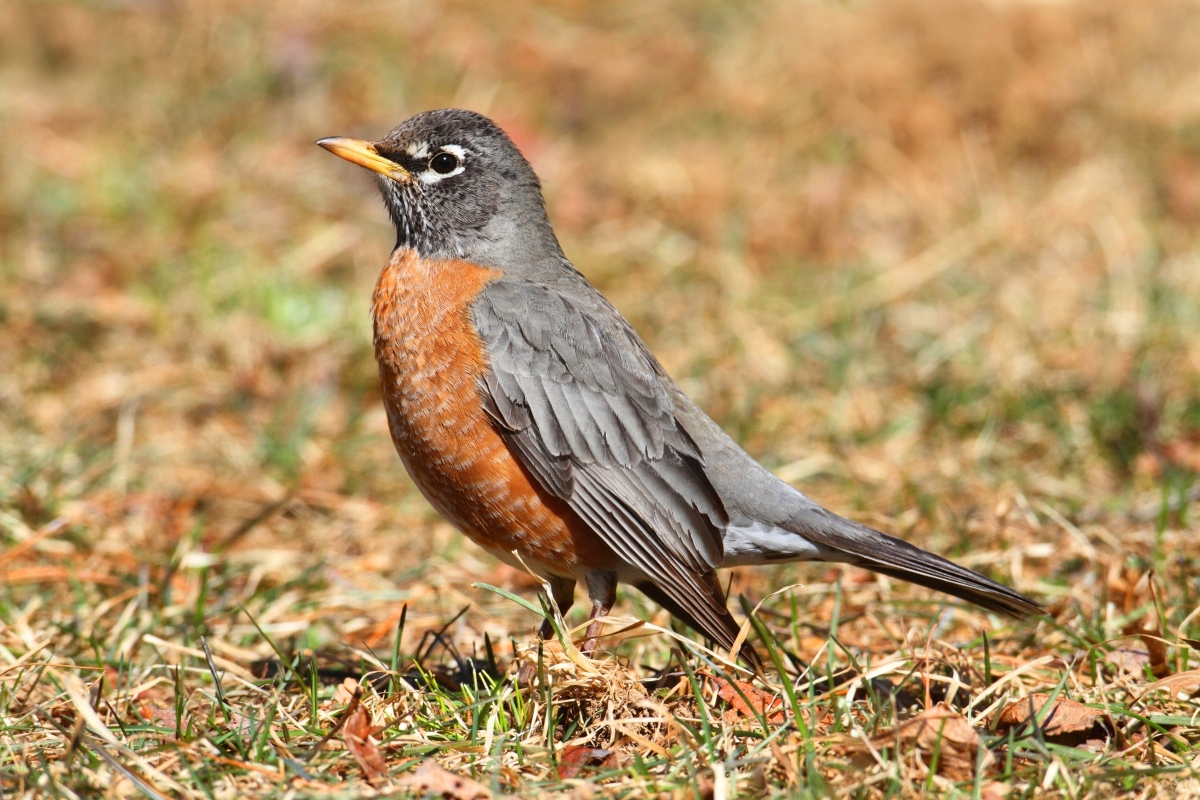
The grackles and blackbirds appear in February in some parts of the United States. Certain populations of the Common Grackle, Brewer’s Blackbird, Rusty Blackbird, American Robin, Killdeer, and Red-winged Blackbird migrate to some extent depending what part of the country they are in.
These birds undergo partial migration patterns, which means that only some part of the population in the country, migrates. The continental United States is a large country, with quite a range in climatic conditions from the northernmost to southernmost states. This means that while conditions in the south may be survivable for some species during winter, the same may not be the case for states bordering Canada.
TIP: Knowing how to spot the birds in your yard is key to enjoying visits from your winged friends as much as possible! The best sources are trusted books, I recommend using the following (Amazon links):
– National Geographic Field Guide to the Birds of North America
– National Audubon Society Birds of North America
There are a few rules or guidelines you should abide by as an ethical birder. These are listed below.
- Do not enter private lands without prior permission from landowners.
- Follow all the rules in refuges and reserves, including cleaning up any garbage from your campsite.
- Do not disturb birds on nests.
- Do not use apps and play songs to call up birds when they are hungry, tired, and breeding during spring and summer.
Grackles
The grackles are quite large birds that are members of the Icteridae bird family. They live in North and South America and some species may migrate short distances when weather conditions deteriorate. Grackles are only found in North America and South America. The male grackle has dark metallic, iridescent coloring and a yellow eye. The female is duller in color, being a dark gray coloring. Not all grackle species in the U.S. are migratory. The Common Grackle, however, is a migratory bird.
Common Grackle

Before migration, the birds may gather in flocks consisting of thousands of individuals. Migration of the Common Grackle is not usually far; it is the populations in the coldest and most northern states that tend to move further south to escape the harsh winter conditions.
These birds eat an assortment of foods and are classed as omnivores. They do like earthworms, insects, and other invertebrates, but will feed on grains and berries as well. They are quite adaptable and tolerant of the cold so many species in the United States do not need to move too far south where they can survive and tolerate the conditions in winter.
Red-winged Blackbird

The Red-winged Blackbird, similar to the Common Grackle does not need to move too far to escape adverse conditions. Populations around the Great Lakes region and in states bordering Canada, will be the birds to migrate further south. The Great Lakes area is known for large snowfalls, which does make it more difficult for small birds to survive. The large snowfalls are known as lake-effect snow, and are due to the high moisture in the area from the Great Lakes.
These blackbirds occur in many states year-round, but in winter, you will notice an influx of Red-winged Blackbird individuals in the more southern areas, like Texas. By spring, the males will have set up breeding territories and you will see them displaying and calling conspicuously from perches. The birds occur in marshes, along wet roadside verges and in salt and freshwater marshy areas.
TIP: Are you looking for high-quality food for wild birds on your backyard? I recommend using Wagner’s products with the highest quality grains used in blending and made in the USA (Amazon links):
– Deluxe Treat Blend Wild Bird Food
– Eastern Regional Wild Bird Food
– Western Regional Wild Bird Food
– Midwest Regional Wild Bird Food
– Southern Regional Wild Bird Food
Rusty Blackbird

This blackbird lacks the bright red markings of the Red-winged Blackbird males. It is a long-distance migrant that can be spotted on migration during February. These birds breed in Canada and overwinter in the southern regions of the United States. They occur in swampy areas which have lots of trees. You can find them at bogs and fens.
If you are in the southern states, you should look around swamps during wintertime, as that is where you are most likely to see them. The birds are insectivores but will also eat fruits and nuts and seeds.
TOP TIP: Some wild birds are friendly – read this article to discover which 6 birds are the friendliest! Do you know that bird watchers have a variety of different names? Some of them are quite funny! Read all about bird watchers and what they are called here.
Killdeer
Killdeer start to migrate to their breeding areas in February. The birds are mainly resident in the southernmost parts of North America, including the United States. This is because conditions are milder in winter, and they are able to cope with the adverse weather. However, the bird is a partial migrant, with northern populations moving south in winter.
They nest in open areas, like fields, but may even choose rooftops. The kildeer has an interesting distraction display where the bird pretends to have a broken wing and will stagger along intentionally, leading a possible predator away from its nest. The nest is just a scrape on the ground with well-camouflaged eggs; young are born precocial.
American Robin
Being such a common bird, we don’t really think of this robin as migrating, but it does in a few places. Some of these birds make a short-distance move from colder regions to warmer locations. It remains resident all year in most of the United States, but North Dakota populations show some migration further south.
Fortunately, American Robins are quite adaptable and can switch their diets to foods like berries and seeds when fewer insects and earthworms are around. The invertebrates tend to either become dormant or die off during the cold months. The more northern states and into Canada, the ground will freeze and there will be snow, making finding food more difficult. Survival also becomes more challenging for the birds at that time.
TIP: Choosing the right bird feeder is crucial when you want to attract birds on your backyard. There are a lot of options on how and where to place a bird feeder. Check out my picks on different bird feeders below (Amazon links):
– Free-standing Bird Feeder
– Hanging Bird Feeder
– Bird Feeder with Camera
Types of Migration

There are different types of migration that occur with birds. It is useful to know that not all birds follow the same pattern of migration. For example, in the case of a partial migration, only some of the individuals in the country migrate. This means, that there are some local populations of the species that do not migrate at all and remain in the same location all year.
A complete migration is when all the individuals in a population leave the area and travel to a new location, where they will remain for a certain period of time, before returning to the place they left. Another interesting form of movement is differential migration. This is when birds of one gender or age migrate first to an area. For example, it might be that males arrive in an area a few weeks before the females of the species.
Irruptive migration is when migration does not occur every year, but there may be movement if food becomes scarce. An example is seen in Blue Jays, which are a species that will only move away from an area if the nuts and other food becomes scarce.
Conclusion
There are some birds that partially migrate to the southern states, such as Florida and Texas, in February. These birds include some of the blackbird and grackle populations of the northern states. February is the coldest winter month and birds will escape the bad conditions by flying down and joining the populations found in the southern states year-round. These are partial migrations because there are many populations of these species that don’t migrate at all in the United States, and instead remain where they are all year.
TIP: Check out my recommended products if you are looking for the best and trusted equipment for birdwatching in the wild or on your backyard (Amazon link):